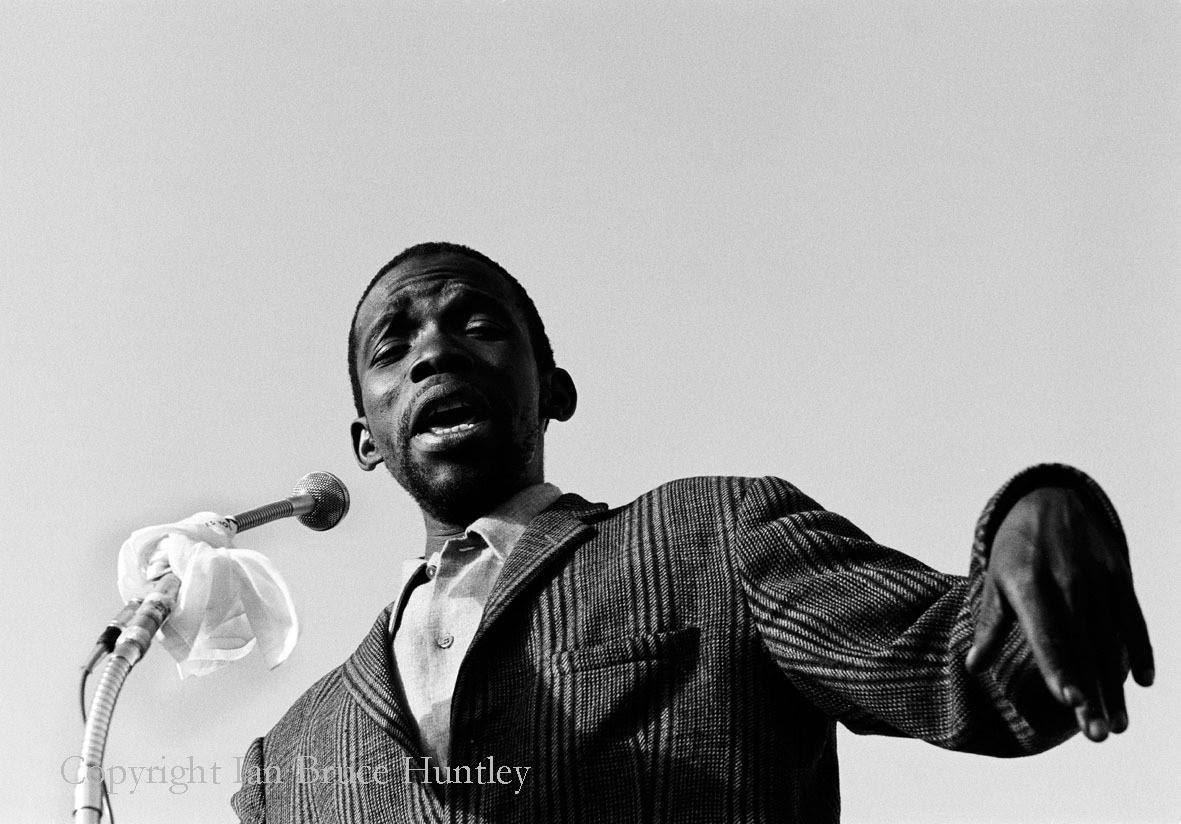
Aspro Sipoya; Langa Stadium, Langa, Cape Town; 1971. From Keeping Time, 1964-1974: The Photographs and Cape Town Jazz Recordings of Ian Bruce Huntley (2013).
The photobook in South Africa: An interview with Sean O’Toole
The Medium as a Site of Struggle. Ideas Letter, 4 September 2026.
HT: Photography is, for me, the most silent of the visual arts—more silent even than painting or sculpture. And so I was struck by how often musical or sonic metaphors come up in this book, whether in your own writing or in what your subjects say about their photographs—almost as if photographs are calling out for precisely what’s not there. It’s very noticeable in Ian Bruce Huntley photographs of Cape Town jazz musicians, Keeping Time 1964-74 (which I’m glad you included, since it’s one of the best examples of the genre in South Africa, among many books on jazz photography). You also write that, as with musical composition, compiling a photobook “requires a mastery of discrete elements like tone, form, and duration.” And then Goldblatt himself uses an intriguingly counterintuitive metaphor when talking about In Boksburg. His aspiration, he says, was “to make a statement in Middle C: right in the centre of the scale. Not dramatize it, not add anything to it at all, just quietly in Middle C.” So I suppose my question is: were you aware of just how much the musical or sonic echoes through the book? And why does it?
SO: In the early 2010s, I worked on an essay about nightclubbing in Johannesburg from the 1950s to the present—not about the music itself, but about the venues where people partied. It turned out to be a profound research project. The history of pleasure in South Africa, a fraught topic, has only been sporadically recorded. Johannesburg, the city where I caroused in my youth, is soberly appraised by writers and photographers in the main. Whether the subject is labor, civil unrest, political disobedience, or white leisure, which endures as a trope, it is chiefly recorded during the day. But there is a counter archive of sorts, often linked to jazz and dance. I first recognized it in Jürgen Schadeberg’s photos of revellers in the 1950s, which in turn enriched my appreciation of Billy Monk’s fascinating yet concise archive of night owls and party folks from late 1960s Cape Town. I’ll be the first to admit that my theory of pleasure after dark is imperfect. Some of Ian Bruce Huntley’s marvelous photos of jazzmen were made in open fields under a blazing sun.